


Madracis-dominated reef (Barbados)
I worked at NOAA’s Atlantic and Oceanographic and Meteorological Laboratory (AOML) from April 2019 to June 2022 as part of the Ocean Chemistry & Ecosystems division). It was an enriching stint that afforded considerable field opportunities throughout the Caribbean and Gulf of Mexico, as well as intensive training in proteomics and “big” data analytics.

Monster O. faveolata colony from The Grenadines.
I was involved in a number of projects while at NOAA and have made a separate page for each. Briefly, they are as follows:

Topside of one of the field site (the main cruise ship channel)

Acropora cervicornis nubbins exposed to 32ºC.
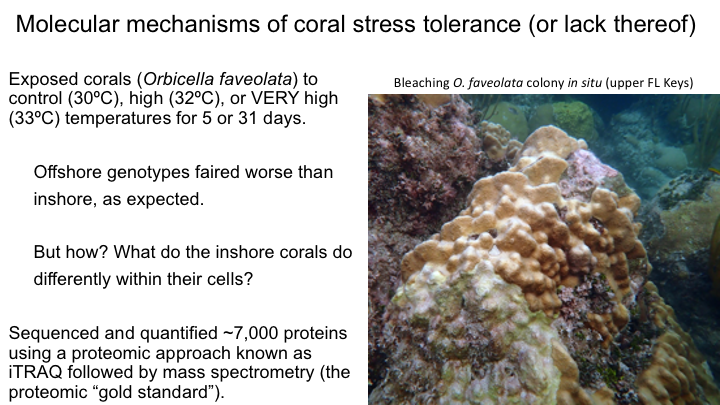
The proteomic basis of thermotolerance in the Caribbean coral Orbicella faveolata. See this paper for the field basis of this study, with final results here.
“Urban Corals,” the brainchild of Colin Foord (Coral Morphologic). The healthiest corals in South Florida are in the Port of Miami…why?! Check out the Coral City Cam. Some preliminary data on this topic can be found here.
Stress-hardening studies in the “Experimental reef lab.” We had previously found that exposure to variable temperatures stress hardens corals, and we have succeeded in doubling the lifespan of acroporid corals at 32ºC by pre-exposing them to a cycling temperature (28-31ºC) regime for several months.
General field assistance, since I love diving. I was also able to dive one of the most beautiful reefs of the Gulf of Mexico, the Flower Garden Banks, as well as St. Vincent and the Grenadines, as part of various, NOAA-funded projects.

Check on the Publications page for articles on these experiments.