

Prony Bay-diving at the base of a nickel mine. Maybe that explains what's wrong with me......Only one day was spent surveying the high coral cover, turbid reefs of this unique area. Prony Bay is a deep, turbid embayment at the southern tip of Grande Terre, New Caledonia, ringed by red ultramafic hills and a nickel mine (about 22.31° S, 166.84° E and 22.37° S, 166.89° E for our two dives).
Max. dive depth=28.7 m
Temperature=24.5°C
Coral cover (2013)=63±5% (mean±standard error)
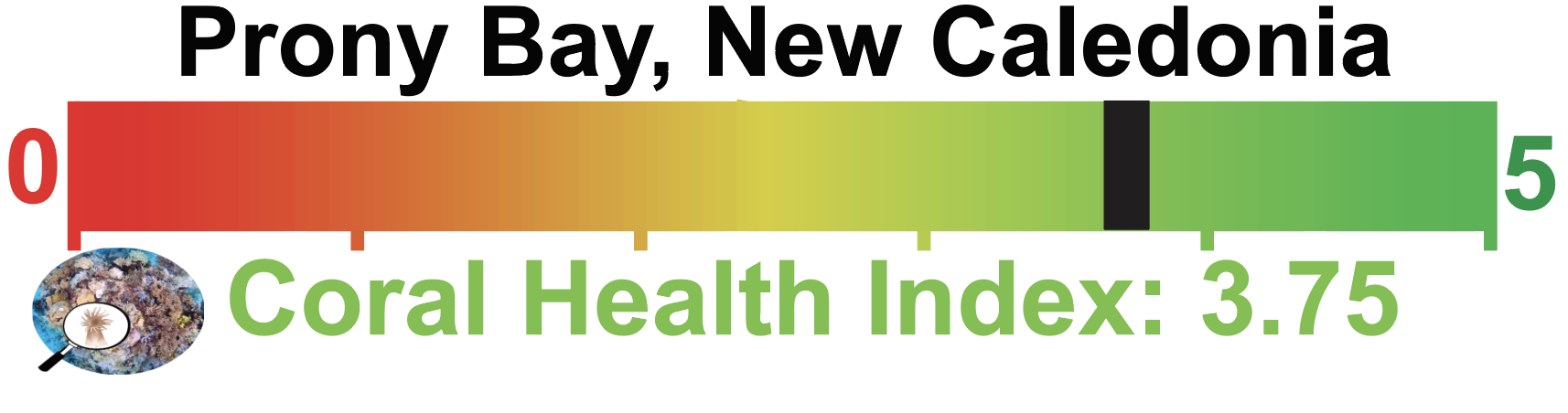
Coral Health Index=3.75/5 (high)

With the Global Reef Expedition, we surveyed two fringing-reef stations in the bay on 4 November 2013. Despite being incredibly murky, the transects recorded 60% and 67% live hard coral: dense branching thickets and stacked plate corals. Fish were sparse, with 11–17 species and roughly 1–2 g/m2 of biomass per station. Of the Pocillopora acuta colonies I sampled, five of seven were 80–100% bleached, against a mean of 8.5% across all colonies scored on the whole New Caledonia expedition. NOAA Coral Reef Watch recorded no heat stress in 2013 (0°C-weeks), so this paleness is consistent with a non-thermal stressor, such as the bay's sediment- and metal-rich runoff.


Better-quality, edited images from Prony Bay can be found here.
NCPB22-first dive at Prony Bay


NCPB22 sampled colonies (n=3)


NCPB23-2nd dive at Prony Bay


NCPB23 sampled colonies (n=4)


Our two papers from this expedition found that Prony Bay had the highest coral cover of the 11 New Caledonian islands surveyed (60±2%) and the highest coral diversity of all 79 sites (Mayfield et al. 2017). Pocillopora from the remote northern reefs and atolls also differed physiologically from those on the more impacted southern reefs around the nickel mine (Mayfield & Dempsey 2022). Under a high-emissions scenario, the New Caledonia ecoregion was projected to reach annual severe bleaching around 2017–2020. The Eastern New Caledonia virtual station has since recorded two severe heat-stress years in a row (2022–2023), peaking at 15.5°C-weeks in 2022.
References
Mayfield AB, Chen C-S, Dempsey AC (2017) The molecular ecophysiology of closely related pocilloporid corals of New Caledonia. Platax 14:1–45. https://www.livingoceansfoundation.org/publication/molecular-ecophysiology-closely-related-pocilloporid-corals-new-caledonia/
Mayfield AB, Dempsey AC (2022) Environmentally-driven variation in the physiology of a New Caledonian reef coral. Oceans 3:15–29. https://doi.org/10.3390/oceans3010002